Trucking routes through Birmingham carry heavy traffic, tight schedules, and constant risk. You see eighteen wheelers on I‑20, I‑65, and I‑59 every day. One mistake can change your body, your job, and your family in a single second. When a crash happens, the route the truck used is not a small detail. It shapes who is responsible, how insurance applies, and what your claim is worth. Police reports, delivery logs, and GPS data often turn on the exact path that truck took through the city. Insurance companies know this and use route confusion to limit what they pay. You do not have to accept that. This blog explains how Birmingham trucking routes affect your rights after a wreck and how a lawyer such as Shaun Capps accident attorney may use route evidence to fight for you.
Why Birmingham Routes Create Unique Crash Risks
Birmingham sits at a crossroads for freight in the Southeast. Trucks use the city as a link between Atlanta, Nashville, Memphis, and the Gulf Coast. That heavy use raises your risk on the road.
Three route features matter most:
- Interstate junctions with fast lane changes
- Steep grades that strain brakes
- Urban exits that mix trucks with local traffic
These features shape how and why a wreck happens. They also shape who may carry legal blame.
You can review freight route patterns and traffic counts through the Federal Highway Administration Freight Analysis Framework. That data often lines up with what you see every day on Birmingham roads.
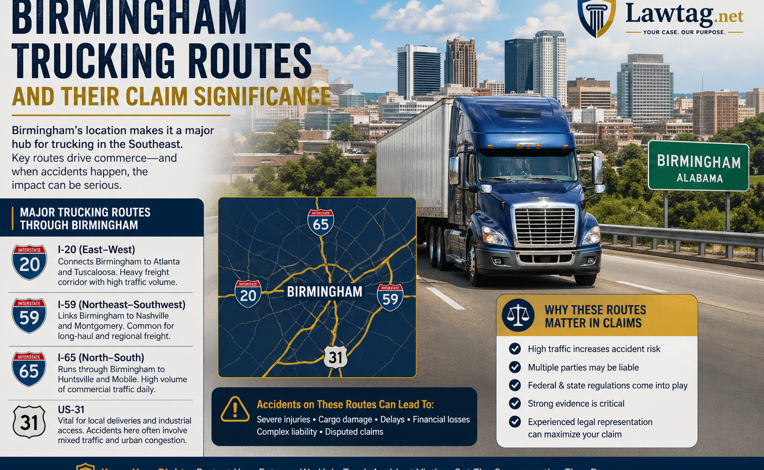
Key Birmingham Trucking Routes And Typical Claim Issues
The route a truck used through Birmingham often points to common patterns. Those patterns affect how your claim unfolds.
| Route | Common Risk Points | Typical Crash Types | Key Claim Questions |
|---|---|---|---|
| I‑20 through downtown | Lane merges, tight curves, construction zones | Rear‑end hits, sideswipes, multi‑car pileups | Was speed unsafe for work zones or traffic flow |
| I‑65 north and south of the city | Steep grades, heavy commuter traffic | Brake failures, jackknifes, underride crashes | Was truck weight, brake care, and spacing safe |
| I‑59 / I‑20 interchange | Complex ramps, quick decisions | Improper lane changes, rollover crashes | Did the driver follow safe lane change rules |
| US‑280 and urban routes | Stoplights, turns, business entrances | Side impacts, pedestrian hits, bike crashes | Was the route suitable for a large truck |
This route detail gives structure to a claim. It shows what a careful driver or company should have done on that exact road.
How Route Evidence Strengthens Your Claim
Route evidence is not abstract. It is concrete proof that supports your story.
Three core sources often matter:
- GPS and electronic logs. These show speed, stops, and duty hours.
- Delivery and dispatch records. These show deadlines and route choices.
- Traffic and road data. These show work zones, closures, and known hazards.
When someone reviews this proof, they can answer hard questions.
- Did the company push the driver to use a faster but less safe route
- Did the driver skip safer bypasses to save time
- Did anyone ignore warnings about grades, curves, or local truck limits
Each answer can shift fault. It can also increase or reduce what insurers must pay.
Route Choice And Trucking Company Responsibility
Trucking companies plan routes. They do not leave that to chance. When a crash happens, those plans come under a microscope.
Three route choices often raise red flags:
- Sending heavy trucks through tight downtown streets
- Routing through known crash hot spots to shave time
- Ignoring weather or grade warnings on steep segments
When a company picks a risky route, it can face added blame. That blame may rest on poor training, weak safety policies, or unrealistic delivery schedules. You do not see those decisions from your car. Route records bring them into focus.
Safety rules from the Federal Motor Carrier Safety Administration set a baseline for route planning, driver hours, and cargo weight. A claim often compares what happened on a Birmingham road to those federal rules.
How Route Details Affect Insurance And Damages
Insurance carriers study routes for one reason. They want to cut what they pay. When they blur route facts, they gain room to dispute fault.
Clear route proof can:
- Show the truck used a road where it should not have been
- Reveal speeding in a work zone or school zone
- Expose sudden lane changes at known merge points
These facts can increase the value of your claim. They show careless or reckless choices. They can also support claims for future medical care, lost work, and family strain, because they make the crash look less like random bad luck and more like preventable harm.
What You Can Do After A Birmingham Truck Wreck
You cannot change the route the truck used. You can act to protect proof of that route.
Right after a crash, you can:
- Call 911 and ask for a police report number
- Take photos of signs, exits, and lane markings
- Record weather, traffic, and any work zones
- Get names and contact details of witnesses
Later, you can request copies of the crash report and medical records. You can also write down your memory of the route, traffic, and the truck’s movements. Simple notes help, such as which exit you planned to use or where you first saw the truck.
Why Route Knowledge Gives You Strength
Trucking crashes in Birmingham are not random chaos. They follow patterns set by roads, loads, and routes. When you understand that, you feel less powerless.
You do not need to master traffic engineering. You only need to know that route facts matter. They shape fault and guide insurance. They help explain your pain to a jury or adjuster.
When someone skilled in truck crash claims studies those routes, you gain a clearer path forward. You gain proof that your harm came from choices made long before the moment of impact. That proof can bring money for care, support for your family, and a measure of peace after a brutal event on a Birmingham road.