When someone is charged with a crime, forensic evidence often becomes the centerpiece of the prosecution’s case. DNA samples, fingerprints, toxicology reports, digital data, and crime scene analysis can seem airtight to a jury that has grown up watching courtroom dramas. But the reality of forensic science is far more complicated than what appears on a screen. A skilled criminal defense lawyer knows that forensic evidence is not infallible. It can be mishandled, misinterpreted, or built on flawed methodology and exposing those weaknesses can be the difference between a conviction and an acquittal.
This article breaks down how criminal defense attorneys approach forensic evidence, what vulnerabilities they look for, and why challenging the science behind the prosecution’s case is often one of the most important strategies in a criminal defense.
Why Forensic Evidence Is Not Always What It Seems
Forensic evidence carries an air of scientific authority that can be deeply persuasive in a courtroom. Jurors tend to trust lab results, DNA analysis, and expert testimony. This trust is not entirely misplaced. When forensic evidence is properly collected, preserved, tested, and interpreted, it can be reliable.
The problem is that the process between the crime scene and the courtroom involves many steps and many people. At any point in that chain, errors can occur. Equipment can be miscalibrated. Lab technicians can be undertrained. Procedures can be skipped. Samples can become contaminated. And in some cases, the underlying scientific method itself may not be as validated as the prosecution claims.
A criminal defense attorney’s job is to scrutinize every link in that chain. If even one link is broken, the evidence may not support the conclusion the prosecution is drawing from it.
Chain of Custody: The Foundation of Evidence Integrity
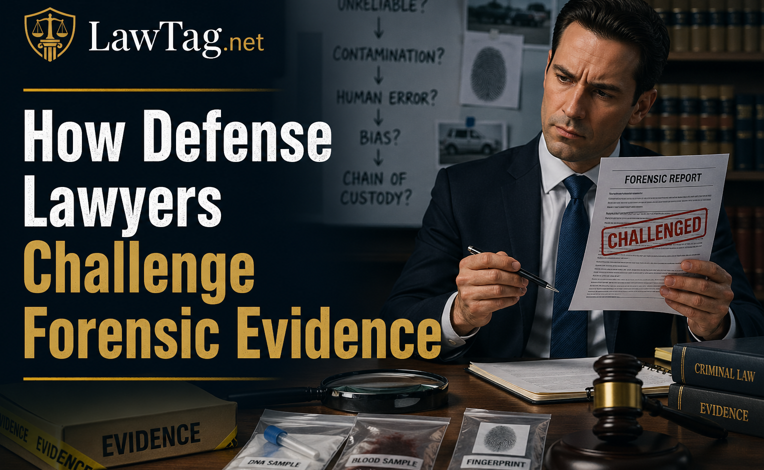
Before a defense attorney even examines the science, they examine the paperwork. Every piece of physical evidence must have a documented chain of custody, meaning a clear, unbroken record of who collected it, who handled it, where it was stored, and how it was transferred from the crime scene to the lab to the courtroom.
If the chain of custody has gaps, inconsistencies, or unauthorized transfers, the integrity of that evidence becomes questionable. Defense attorneys will request all documentation related to how evidence was collected and stored. A missing signature, an undocumented transfer, or an unexplained gap in the timeline can raise legitimate doubt about whether the sample tested in the lab is the same one collected at the scene.
This challenge is not a technicality for technicality’s sake. It goes to the heart of whether the evidence can be trusted at all.
Challenging the Science: Is the Method Reliable?
One of the most powerful tools a criminal defense lawyer has is questioning the scientific validity of the testing method itself. Not all forensic disciplines are created equal.
Some forensic sciences, like DNA analysis using established protocols, are built on strong statistical foundations and extensive peer-reviewed research. Others have faced increasing scrutiny from the scientific community, including:
- Bite mark analysis: The National Academy of Sciences and the President’s Council of Advisors on Science and Technology have raised serious concerns about the reliability of bite mark comparisons as evidence.
- Hair microscopy: Before DNA testing became standard, hair analysis was commonly used. The FBI itself acknowledged in 2015 that microscopic hair analysis had been overstated in thousands of cases.
- Bloodstain pattern analysis: While useful as an investigative tool, interpretations of bloodstain patterns can involve significant subjectivity.
- Firearm and toolmark examination: The degree of certainty with which examiners can definitively match a bullet to a specific weapon has been challenged in scientific literature.
Defense attorneys work with their own forensic experts to evaluate whether the methods the prosecution used meet acceptable scientific standards. If a method lacks peer review, has known error rates that were not disclosed, or relies heavily on subjective interpretation, it can be challenged under evidentiary standards. In federal courts and many state courts, the admissibility of expert testimony is evaluated under the Daubert standard, which requires that the science be based on sufficient facts, a reliable methodology, and proper application of that methodology to the facts of the case.
Lab Errors and Contamination
Even when the underlying method is sound, the execution in the lab may not be. Forensic laboratories are not immune to human error.
Defense attorneys regularly request access to:
- Lab protocols and standard operating procedures
- Maintenance and calibration records for equipment used during testing
- Proficiency testing results for the analysts who handled the evidence
- Documentation of any deviations from standard protocol
- Any prior audits or quality control issues at the lab
If a lab has a history of procedural violations, if equipment was not properly calibrated, or if cross-contamination occurred during processing, those facts are highly relevant to how much weight the forensic results should carry.
The goal is not to attack science broadly. It is to hold the specific people and processes involved in a specific case to the same standard of rigor the prosecution expects jurors to extend to the evidence.
Expert Witnesses: Fighting Science With Science
Criminal defense attorneys often retain their own forensic experts to review the prosecution’s findings and offer an independent analysis. This is one of the most effective ways to challenge forensic evidence because it shifts the dynamic in the courtroom.
Instead of simply arguing that the prosecution’s expert is wrong, the defense presents an equally credentialed professional who can explain, in terms a jury can understand, why the results are ambiguous, why the methodology is flawed, or why a different interpretation is more scientifically defensible.
Defense experts may be called to address:
- DNA mixture interpretation (when more than one contributor is identified in a sample, analysis can become highly complex and contested)
- Toxicology results in DUI cases, where the timing of a blood draw relative to the time of driving matters significantly
- Digital forensics, where metadata and file timestamps can be misread or misrepresented
- Medical evidence in assault or homicide cases, where the cause or timing of injuries is disputed
The ability to retain, prepare, and effectively present expert witnesses is one of the hallmarks of an experienced criminal defense attorney. It transforms a courtroom confrontation from a one-sided presentation of science into a genuine factual dispute.
The Prosecution’s Expert Witness: Cross-Examination
Even when the defense does not retain its own expert, the prosecution’s expert witness can be cross-examined. A thorough criminal defense attorney prepares extensively for this portion of trial. Effective cross-examination of a forensic expert might include:
- Establishing the expert’s limitations in the specific area tested
- Highlighting that the lab’s error rate was never disclosed to the jury
- Pointing out that the expert did not personally conduct all portions of the testing
- Surfacing prior inconsistent opinions the expert has given in other cases
- Demonstrating that the conclusion presented as definitive was actually probabilistic
Jurors often walk into court believing that forensic science speaks for itself. Cross-examination can show that behind every report is a person who made choices, and those choices can be questioned.
When Forensic Evidence Was Obtained Illegally
A completely separate but equally important avenue of challenge involves how the forensic evidence was obtained in the first place. Even if the science is reliable and the lab procedures were followed, evidence collected in violation of the Fourth Amendment’s protection against unreasonable searches and seizures may be suppressed.
If law enforcement conducted a search without a valid warrant or a recognized exception to the warrant requirement, the resulting evidence, including forensic samples, may be inadmissible. This is known as the exclusionary rule. Defense attorneys file pretrial motions to suppress when the circumstances of the collection were constitutionally defective.
Suppressing key forensic evidence does not automatically result in a dismissal, but it can significantly weaken the prosecution’s case or change the calculus around a plea offer.
The Bigger Picture: Forensic Evidence Is a Starting Point, Not a Conclusion
The most important takeaway for anyone facing criminal charges is this: forensic evidence is not a verdict. It is data. And like all data, it depends entirely on how it was gathered, how it was analyzed, and how it is interpreted.
The criminal justice system requires the prosecution to prove guilt beyond a reasonable doubt. When forensic evidence is properly scrutinized, it often raises more questions than it answers. A qualified criminal defense attorney understands both the science and the legal framework surrounding it, and can use both to build a defense that holds the prosecution to the full burden they are required to meet.
If you or someone you know is facing charges where forensic evidence is involved, seeking experienced legal representation as early as possible is critical. The way evidence is challenged, and when, can significantly affect the outcome of a case.
This article is intended for general informational purposes only and does not constitute legal advice. Laws vary by jurisdiction. Consult a qualified criminal defense attorney for guidance specific to your situation.