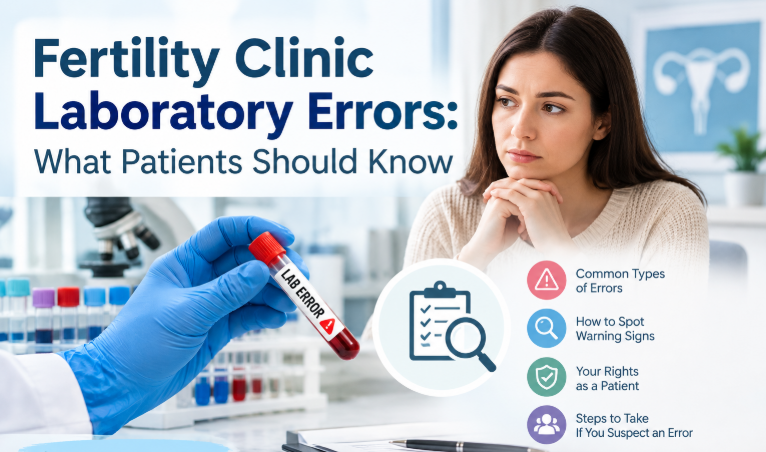
When patients think about IVF, they often picture appointments, medications, egg retrieval, and embryo transfer. Some of the most important parts of treatment, however, happen inside an embryology laboratory that patients rarely see.
Eggs, sperm, and embryos must be identified, handled, cultured, tested, frozen, stored, thawed, and prepared for transfer under carefully controlled conditions.
Most fertility laboratories have extensive safeguards designed to prevent mistakes. But when laboratory systems fail, the consequences can be significant and sometimes irreversible.
Why the IVF Laboratory Matters So Much
The laboratory plays a central role in an IVF cycle.
Following egg retrieval, embryologists identify the retrieved eggs and prepare them for fertilization. Sperm specimens must also be correctly identified and handled before fertilization occurs.
Embryos may then remain in the laboratory for several days while their development is monitored. Some are biopsied for genetic testing, while others may be frozen for future use.
Each stage introduces procedures that must be performed accurately.
Identification Is Critical
One of the most fundamental responsibilities of a fertility laboratory is making sure reproductive material belongs to the correct patient.
Eggs, sperm, and embryos can pass through numerous laboratory steps before an embryo is eventually transferred.
Identification and witnessing systems are intended to maintain the connection between each specimen and the correct patient throughout that process.
A breakdown in those safeguards can potentially result in the wrong sperm being used, embryos being mislabeled, or the wrong embryo being transferred.
What Types of IVF Laboratory Errors Can Occur?
Fertility laboratory mistakes can take many forms.
Potential errors may include:
- Mislabeling embryos, eggs, or sperm
- Using reproductive material belonging to another patient
- Transferring the wrong embryo
- Improper embryo handling
- Problems during embryo freezing or thawing
- Failure to maintain appropriate incubator conditions
- Cryostorage or monitoring failures
- Documentation mistakes
- Errors involving embryo biopsy samples
- Incorrect communication of laboratory information
An unexpected IVF outcome does not necessarily mean that one of these errors occurred. Embryos can stop developing even when appropriate procedures are followed.
The distinction becomes important when evidence suggests that a preventable laboratory failure contributed to the loss.
Embryo Mix-Ups Can Have Permanent Consequences
Few laboratory errors illustrate the importance of identification procedures more clearly than an embryo mix-up.
If the wrong embryo is transferred, patients may not discover the mistake until pregnancy has already occurred or a child has been born.
Errors involving sperm or eggs can create similarly profound consequences.
These incidents can raise complicated questions involving medical negligence, reproductive rights, parentage, emotional harm, and damages.
They also demonstrate why IVF laboratories typically employ multiple verification procedures rather than relying on a single person or label.
Embryo Loss Is Different From an Unsuccessful Transfer
There is an important distinction between an embryo that does not implant and an embryo that is lost because of a preventable laboratory event.
IVF cannot guarantee that an embryo will develop normally or result in pregnancy.
However, patients reasonably expect clinics to maintain appropriate systems for protecting embryos while those embryos remain under the clinic’s control.
Equipment problems, storage failures, handling errors, incorrect laboratory conditions, or inadequate monitoring can raise very different questions from the biological uncertainties associated with IVF itself.
For some patients, lost embryos cannot simply be replaced with another IVF cycle. Age, diminished ovarian reserve, medical history, or other circumstances may make creating additional embryos difficult or impossible.
Genetic Testing Adds Another Layer of Complexity
Preimplantation genetic testing can involve several organizations beyond the fertility clinic itself.
An embryology laboratory may biopsy cells from an embryo before those samples are sent to a separate genetic testing laboratory.
That creates several points where accurate identification and communication become essential.
A sample mix-up, labeling error, reporting problem, or other preventable mistake can affect which embryos patients choose to transfer or preserve.
When investigating a suspected genetic testing error, determining exactly where the process failed may therefore be critical.
When Can a Laboratory Error Become IVF Malpractice?
A laboratory mistake does not automatically establish a medical malpractice claim.
The circumstances surrounding the error, applicable standard of care, resulting harm, and relationship between the mistake and the patient’s damages all matter.
Fertility Law Group, a law firm focused on IVF malpractice and fertility clinic negligence, notes that these cases can require investigation beyond traditional medical records. Embryology records, laboratory logs, storage documentation, genetic testing reports, and internal protocols may provide important information about what occurred.
That makes IVF laboratory cases considerably different from many conventional medical malpractice claims.
What Should Patients Do If They Suspect an IVF Laboratory Error?
Patients who receive unexpected information from a fertility clinic should document what they are told.
It can also be helpful to preserve emails, patient portal messages, consent forms, embryology reports, genetic testing reports, invoices, and other treatment records.
Patients should ask the clinic for a clear explanation of what occurred and which embryos or reproductive materials were affected.
If a clinic offers reimbursement, compensation, or a release following a serious error, patients may also want to understand their legal rights before signing documents.
An IVF malpractice lawyer familiar with fertility laboratory cases can review the circumstances and determine whether additional records or investigation may be appropriate.
Why Specialized IVF Malpractice Experience Matters
Fertility laboratory cases sit at the intersection of medicine, embryology, genetics, laboratory operations, and medical malpractice law.
Understanding what happened may require reconstructing events that occurred entirely outside the patient’s view.
That can mean determining who handled reproductive material, which identification procedures were followed, what laboratory conditions existed, and whether required safeguards operated as intended.
Fertility Law Group has focused its practice on IVF malpractice cases involving issues such as embryo loss, embryo mix-ups, wrong sperm or egg use, genetic testing errors, and fertility laboratory negligence.
For patients confronting an unexplained IVF laboratory event, understanding exactly what happened is often the first step toward understanding whether it was an unavoidable outcome or a preventable error.